Take that shot! ... and sharpen that pencil, too
Brahma
05 Jan 2009
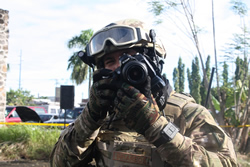
How many times have you heard: such and such sporting activity gets plenty of coverage in the local newspaper, magazine or the Internet, and yours doesn't get any? Is there anything you can do about it? You certainly do! As an airsoft enthusiast, I am usually on the lookout for "high-profile" airsoft events or an interesting weekend skirmish that promises loads of photo opportunities and some interesting articles to boot. More often than not, I (together with Ogre, mostly) end up covering such events. You can most likely do the same, too.
Many local newspapers and publications welcome article submissions and appreciate someone taking the time to do them. It helps them cover a wider variety of interesting topics, not to mention sales of their publications, too. Don't expect to be paid though, but the publication might just offer you a freelance gig and put you on their on-call list of photographers for covering other events in your area.
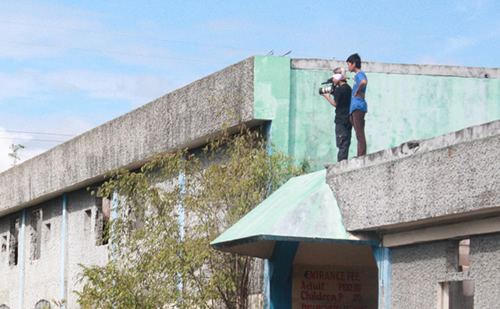
Some important factors to consider when covering an airsoft event are as follows:
- Timeliness. Photos and write-up should be current. Nobody wants to read about an event that happened years ago, unless you're researching for a history project.
- Objectivity. The situation implied by the photos is a fair and accurate representation of the events they depict in both content and tone.
- Narrative. The images seamlessly combine with other news elements in conveying the story and to make the facts understandable to the reader on a cultural level.
Talk to people who know. The first step is to talk to the organizers beforehand and ask them if you can cover their event. You can also approach the various participating teams and ask for some tidbits or sidelights about the event. It will help you in doing the write-up part of it, especially if you don't know what it is all about. Second, try to contact your local airsoft magazine, better yet, get in touch with the sports editor of your local newspaper and advise him/her of your upcoming contribution. Don't be afraid to ask them for advice and suggestions. Ask them what they would expect you to be submitting to them, sort of an outline.
When covering competitions or tournaments, it helps if you identify each team. This will give you a general idea of who to follow when the game starts. Don't hesitate to ask for a quick debrief of some teams after their run-how difficult the mission was, how many casualties the team suffered, was the run successful or was it mission failed. That helps a lot with the write-up. Another way to go about it is to ask the judges or marshals or the organizers for a copy of the roster of participants. If it's too much for you to do, team up with another enthusiast. One doing the photos and one doing the write-ups. You can both most likely run up and down the sidelines together.
Be prepared for the elements. Rain or shine, sometimes you'll have to be out there shooting, which means your camera is going to take a beating. Have a sun-shield in your camera bag to protect the lens from sun flare. Invest in a UV filter to help protect the lens from scratches. Have a plastic bag, plastic sheet or cover with you to put over your camera when it starts to rain. If it's cold, keep your camera under your jacket and close to your body heat whenever possible; this will prolong your battery life and keep your camera's electronics from freezing. Also, keep your camera bag clean. If you find yourself changing lenses often, and quickly, you don't always have time to put the lens cap back on. A dirty camera bag can scratch and hurt lenses, so keep it free from dirt, pebbles, and other debris that may get in there.
Always create a checklist for yourself. When you arrive at that event, you've got a few strides to think before its shooting time-lens cap (off), camera (on), check camera settings, shoot. Having a short checklist and less camera settings to worry about affords you more time to scope out your surroundings for the best possible angle.
Always carry a spare battery. That's worth repeating: Always carry a spare battery. Always.
Pick up that camera. All you need is a camera with zoom lens and start taking those airsoft action photos (you can find some tips on airsoft combat photography in this issue to further hone your skills). The more photos you take the better chance you have of getting better pictures. That's one advantage of having a digital camera. It's best to go digital nowadays to cut down on expenses, and for that reason, alone.
You don't need high-tech stuff at the onset. If you have a digital camera, remember to just keep it simple. Shutter speed, aperture, white balance-a good camera has a hundred little gizmos that can help you get the best photos possible, but all of them are useless unless they're set to match the conditions you're shooting in. You're going to miss a lot of shots if you have to change your camera settings every ten minutes and shooting in fully automatic mode is risky. Just put the control to sports/action or the like on your control knob because you want to "freeze the action" and not on "portrait" which will show the motion of running player and most likely blur the output.
If your camera offers you a manual shutter speed mode or an aperture priority mode pick one of those and stick with it. Start with aperture priority and an ISO of 400 and let the camera's automatic shutter speed do the rest. This leaves you with fewer settings to fret over and more time to compose your shots. On sunny days, 400 ISO would do. On rainy or cloudy days or late evening, 1000 or 1600 ISO would do the trick.
Another very important thing to remember is to leave the flash turned off. The camera's flash is distracting to the players and could interfere with their action performance. As in any outdoor sporting event, keep the flash off, especially if you are up close to the action. For speedball-type events, make sure that you are packing an extremely powerful zoom lens, like a 500mm or higher. A flash from that distance is more or less useless.
It pays to know your lenses too. If you're fortunate enough to have the $10,000 lens that will go from 20mm to 400mm, hurray for you, but if you're like the rest of us, you probably have two or three lenses, and knowing what they are capable of is essential. If you plan on covering a speedball-type tournament or MOUT scenarios, a telephoto lens is probably what you want. The long focal length of the lens will give you shallow depth of field, eliminating distracting background objects, and it will get you right in on the action when you will probably have to stand far away. If this is the route you take, a tripod or a telephoto lens with image stabilization is almost a necessity. However, if you're going to a jungle skirmish, chances are a 35mm to 80mm lens will be fine. It will give you some range, but also the option to take some quick portraits here and there.
Also, most digital cameras offer a "high contrast" option which not only looks great in most color photos, but works wonders when converting those color photos to black-and-white. If you don't have that option, consider investing in some filters. A polarizing filter is almost a necessity for any on-the-go photographer because it can minimize glare and darken bright objects with a simple turn of the filter. For strictly black-and-white photography, a red filter, for example, is great for darkening bright blue skies while a green filter will help cut through haze.
All of the above doesn't mean that you should not ever shoot in full manual mode. By all means, if you know you're going to be in the middle of a skirmish under the bright sun for three hours, put the camera on whatever settings you need for consistency's sake. But keep the above in mind so that when that hectic day of shooting comes along you won't be wasting time turning and resetting all the gizmos on your camera.
Common Camera Settings for Action Shots
When taking photos of fast moving subjects, it's important to use the right camera settings. If a digital camera doesn't have semi-automatic or manual modes, use Sports or Fast Shutter Speed Mode.
In addition to settings, techniques such as panning will create dynamic-looking effects. Some techniques require extra skills so practice lots before the actual event you wish to photograph.
Digital camera settings
ISO/sensitivity - Set your cameras sensitivity to the highest usable ISO setting to "freeze action." If it's bright out, use between ISO 50 and 100 to get the highest possible shutter speed. Use higher ISO numbers only if you have no other choice since on most consumer compact digital cameras, high ISO numbers produce visible noise in images.
Use varied shutter speeds - Fast shutter speeds - to capture stop action. Slower shutter speeds - to capture motion.
Use continuous (burst) mode - Continuous modes let you take photos in rapid sequence. Very useful to photograph an unpredictably moving subject, or to capture movement in a series of images.
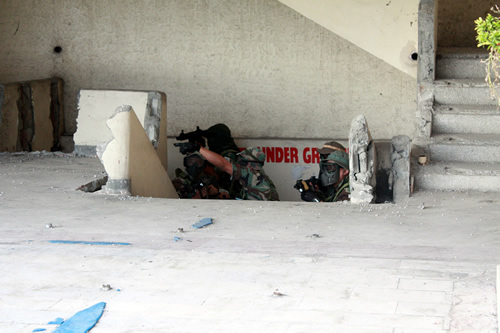
Run with the bulls. Don't stand in one place. Most publications prefer photos that can tell a story, even without the captions. If possible, follow the action up and down the sidelines. For defend scenarios, try to be ahead of the assaulting team or behind the defenders in order for you to capture images from the offensive and defensive players' point-of-view. When photographing people, remember to capture emotion as well as motion. Capturing a player's expression in the heat of combat is equally important when structuring your photo essay. When taking your game action photos, try to familiarize yourself with the game scenario, so as to know where to get the best action shots. Always be respectful and discreet. Some players may not like it when you're in the way, or when you're blocking their line of fire.
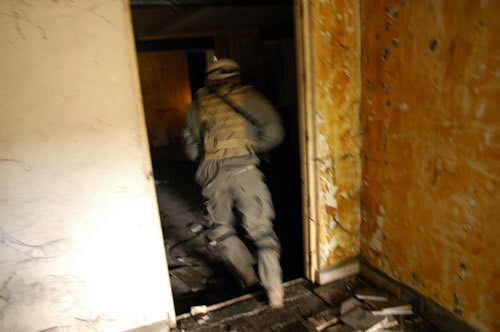
Your camera may not be fast enough to focus on a fast moving subject. Overcome this by prefocusing on something else of equal distance where the subject will come into view. Depress the shutter-release button half-way to lock focus and exposure. While holding it down, recompose but don't fully depress the button until the subject appears. You may have to pan a bit to follow the subject. If your digital camera has a "quick release" setting or "high speed" mode, use it. Check the manual for other camera-specific prefocusing options, such as Manual focus and Focus Lock settings.
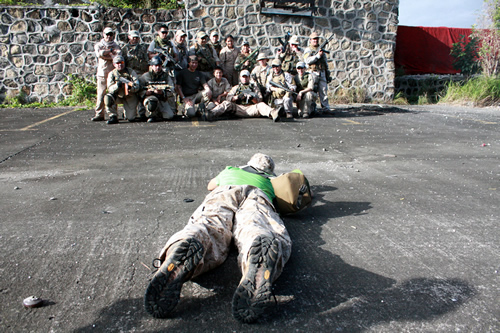
Remember to be real with your expectations. When you're covering certain airsoft events, you don't always have access to perfect lighting or the time or space to position yourself where you really want to be. Sometimes you've got to take what you can get and that means learning to make the best out of what you're given. Kneel down low, shoot between somebody's knees; always look for that angle that others won't have.