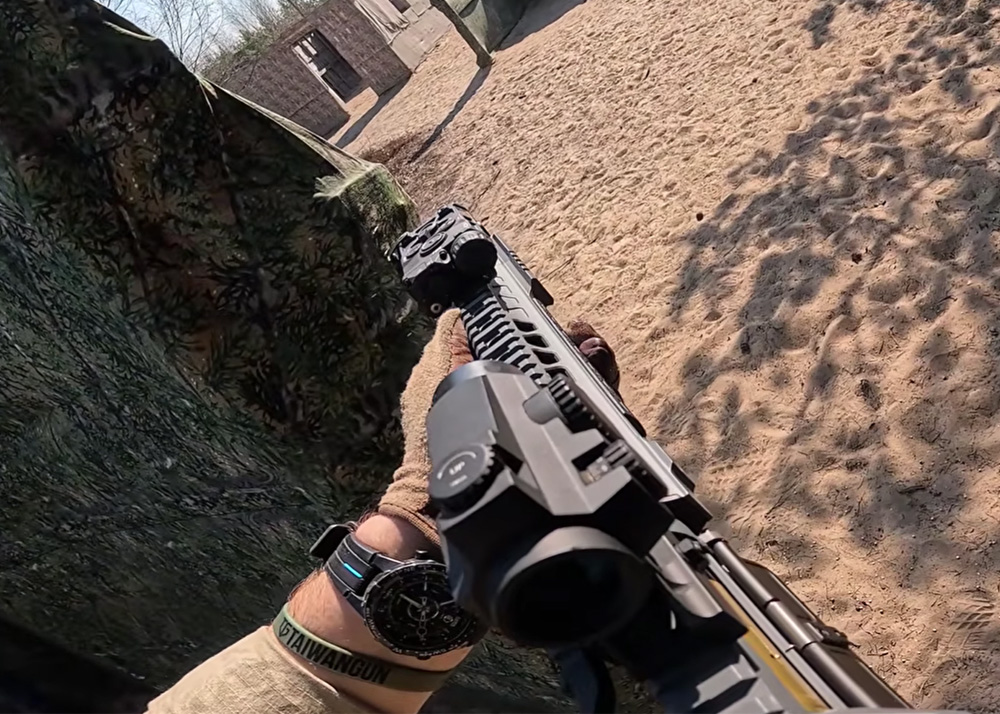
Falcon Claw compares two tactical thermal setups: a dual-band system (a dedicated thermal monocular bridged with night vision) and a binocular system using a clip-on thermal overlay. Through field tests in a wooded environment, he evaluates how each configuration performs in real-world scenarios, specifically focusing on detection range, ease of use, and movement.
Falcon Claw compares the EOTech and Aimpoint T2 red dot sights, focusing on their performance with night vision and thermal optics. The EOTech is highly praised for its large viewing window, exceptionally clear holographic glass, and its dedicated night vision button, making it a superior choice for passive aiming and Close Quarters Battle (CQB) due to better parallax forgiveness.
Falcon Claw evaluates the effectiveness of a thermal monocular setup versus night vision binoculars in tactical scenarios, testing both through recorded one-on-one games. The thermal monocular consistently outperforms night vision, detecting heat signatures in challenging environments and proving crucial in conflict situations, while night vision remains useful for navigation.
In this Falcon Claw video, Estonian sniper conscripts are tasked with establishing concealed urban positions within an hour, effectively hiding from both thermal and standard optics. This involves ensuring a clear line of sight, utilizing room depth and solid materials for thermal concealment, creating small loopholes for equipment, and minimizing light from windows and overhead to prevent silhouetting.
Falcon Claw show their products for use with night vision devices. The Infinity Cap, made from tough aluminum, protects Night Vision Devices (NVGs) with a threaded attachment and an o-ring to prevent dust and debris. It also features a sacrificial lens and a click-stop adjustment system that allows for quick and precise focusing from close range to infinity, even in changing light conditions.
We don't recommend you doing this when the Night Vision device is being worn by person. https://www.youtube.com/@falconclaw_Falcon Claw tests how bright lighting affects night vision devices up, as well as including lasers in the test. Also, beware of flashing lights in the video... "Night visions amplify light, right? But now, a question arises - if there’s too much light, will it overwhelm the device? Will there be any damage? What sort of? How quickly damage can appear?
The Latest News