Beretta's 94X Performance Takes the 90 Series Further Than Ever At The Range
Gungho Cowboy
10 Jun 2026
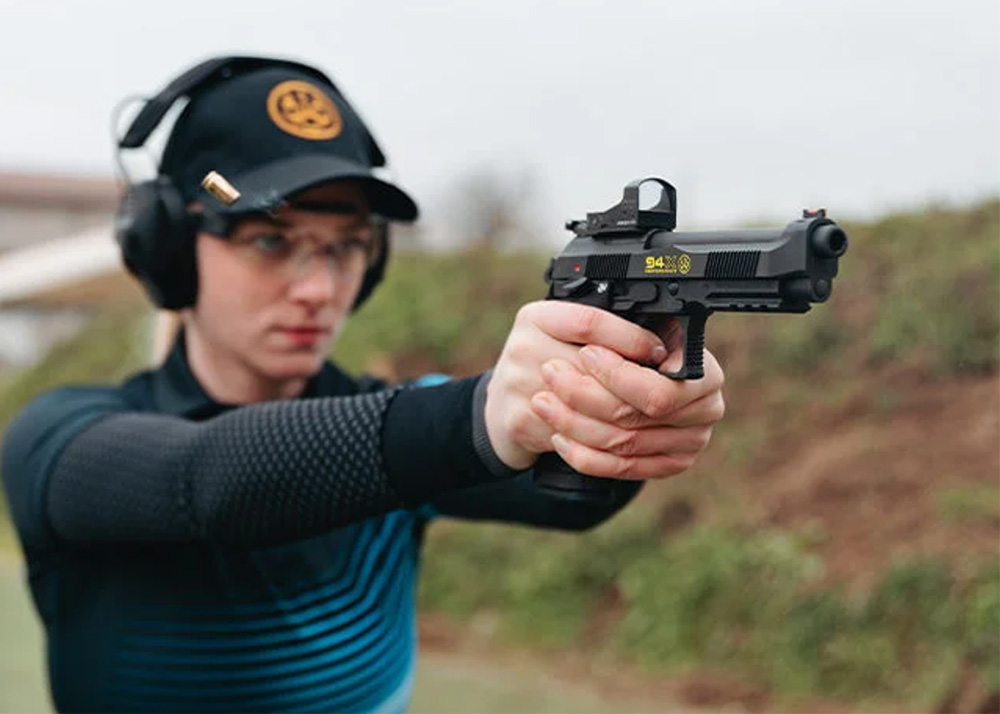
When the world’s oldest industrial dynasty decides to refresh its competition lineage, the shooting community tends to pause, clear its collective throat and pay attention. Beretta has launched the 94X Performance, a platform engineered for the high-speed worlds of IPSC and USPSA. It looks like the Italian manufacturer has looked at the hectic nature of modern practical shooting and decided what competitors really need is a bit less chaos and a lot more mechanical composure.

Central to the 94X Performance is the new Vertec Pro frame, an extended steel chassis that raises and deepens the grip geometry to place the shooter's hand higher and closer to the bore axis. This is not simply an ergonomic preference as physics has a say. A higher grip position reduces the mechanical leverage that drives muzzle rise, which means the gun returns to target faster after each shot, a matter of genuine consequence when IPSC stages demand rapid transitions between multiple targets. The longer frame geometry functions much like an extended lever arm, working against recoil rather than surrendering to it. For a discipline in which a fraction of a second separates a classification from a commendation, this sort of engineering is not cosmetic.
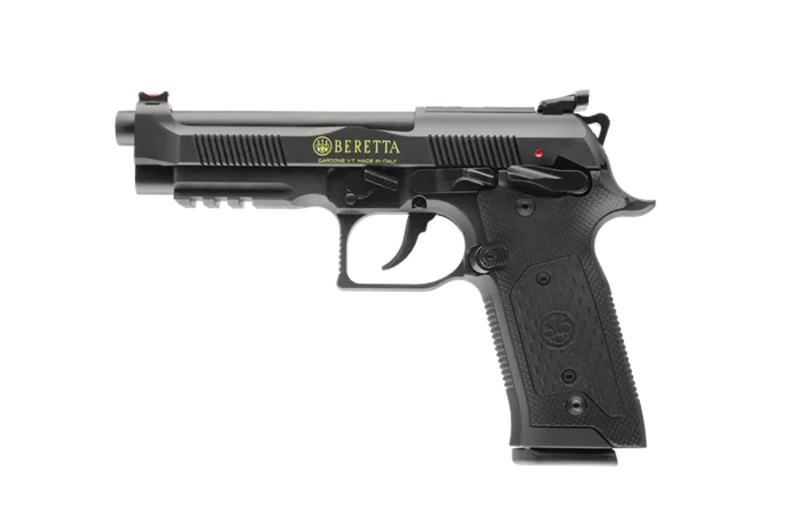
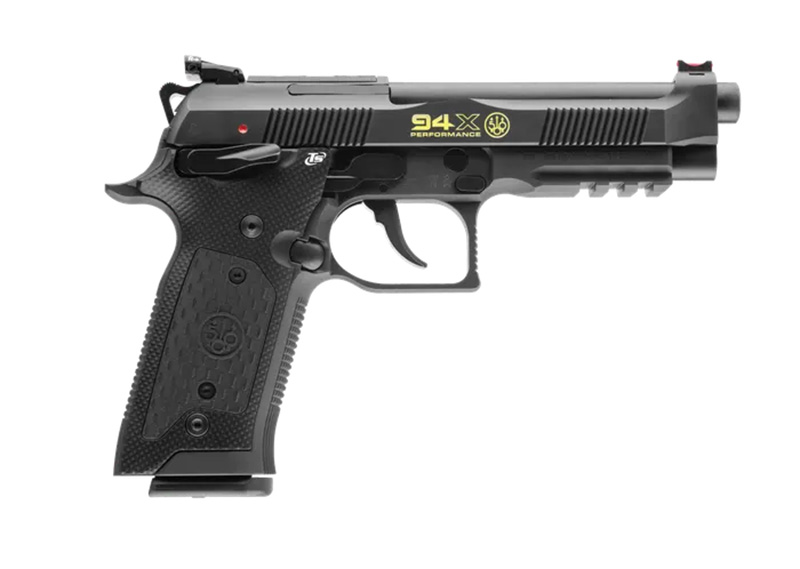
Control during rapid fire is further enhanced by an upswept beavertail profile and a raised trigger undercut. The beavertail sits higher on the web of the hand, preventing the slide from introducing itself to the shooter's palm in an unpleasant way, while the trigger undercut allows the grip to sit even higher still. Combined with newly reshaped polymer grip panels featuring a palm swell, and aggressive frame checkering with contoured serrations that are 30 per cent wider and deeper than before and angled at 15 degrees, the result is a pistol that stays put in the hand rather than migrating about with each discharge. Gloves, sweat, adrenaline are not invited to interfere.
The slide has been reworked with the optics-first shooter firmly in mind. The RDO, the recess machined to accept a miniature red-dot sight, has been repositioned 3 mm lower than on earlier Beretta designs. That small measurement carries significant consequence: the optic now aligns more naturally with the barrel axis, reducing the chance of ejected cases clipping the sight body and preserving the zero during long matches. It also lowers the centre of mass of the slide assembly, which improves recoil management and helps keep the dot in view between shots. Beretta has also arranged access to the extractor without requiring removal of the red-dot plate, which means routine maintenance no longer demands a complete re-zeroing exercise. This is the sort of thoughtfulness that makes an engineer popular at prize-giving ceremonies.
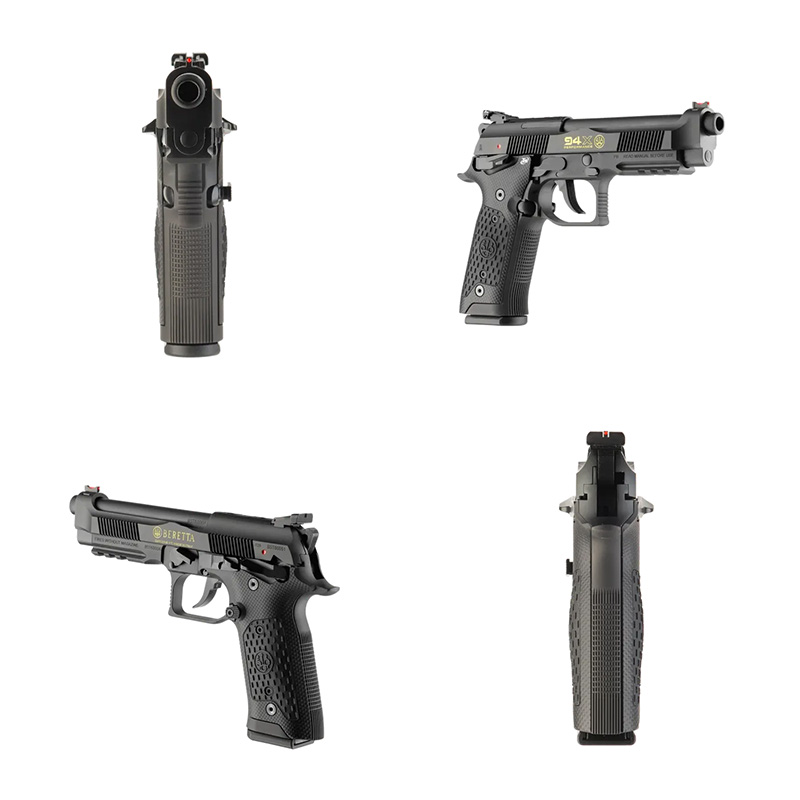
The barrel itself deserves a paragraph of its own. Whilst Cold-hammer forging is nothing new at Beretta as the process has long been central to their manufacturing philosophy, the 94X Performance introduces an advanced steel formulation specifically intended to withstand the kind of round counts that competition shooters accumulate. A serious IPSC competitor might put ten thousand rounds through a pistol in a season without blinking; a barrel that degrades at four thousand is not, in that context, an asset. The new metallurgy extends service life considerably, while the forging process keeps the precise concentricity between chamber and bore that underpins consistent accuracy. The barrel is, in short, built to outlast its owner's enthusiasm, which is rather the point.
Feeding into the reliability story is a redesigned firing pin and extractor assembly. The firing pin is longer than its predecessor, producing more energetic strikes on primers and thereby improving ignition consistency. This is particularly relevant when using ammunition at the harder end of the primer-sensitivity spectrum. An integrated elastomer buffer in the extractor stabilises the extraction movement, smoothing what can otherwise be a somewhat violent interaction between fired case and extractor hook. This is the sort of invisible engineering that manifests as a pistol that simply works, shot after shot, without any drama.
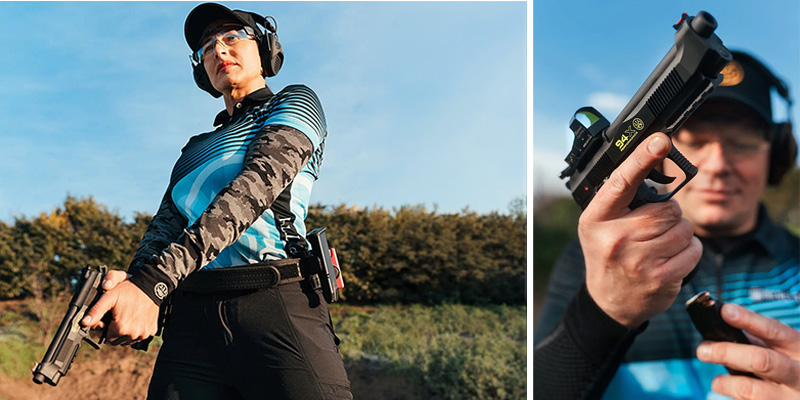
An important component of the handgun, which is the trigger, is the Xtreme-S system. Beretta has refined this mechanism to deliver a short, fast, and intuitively consistent reset: the distance the trigger must travel forward before it is ready to fire again is as brief as the engineers could manage without compromising the safety standards Beretta refuses to negotiate on. The Xtreme-S achieves this by releasing the firing pin only at the precise moment of the shot, via an advanced firing system that prevents accidental discharge even under impact or harsh handling. An optional performance kit is available to refine the pull weight further, offering a lighter and smoother action in both double- and single-action modes for those who want to squeeze every last millisecond from the system.
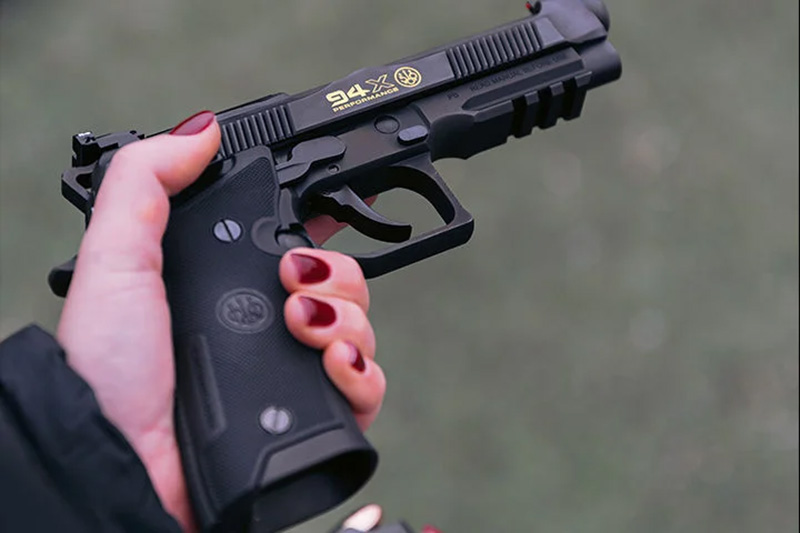
The safety levers have been redesigned to sit flush with the rear of the frame, reducing the chance of snagging during a draw or re-holster, while the front face is wider to improve the contact surface for disengagement under pressure. The slide catch lever has been thinned and angled for cleaner interaction, and the magazine release is reversible as it is configurable for either hand, with an orientable option on the Launch Edition model. Sights are a 1 mm fibre-optic front post and a blacked-out, serrated, negatively inclined rear, the latter designed to minimise light reflection and present a clean sight picture in varied conditions. The magazine holds 20 rounds flush, a meaningful step up from the 15-round capacity of the standard 92-series, and the 94X magazines are compatible with the broader Series 90 family, though not vice versa.

For those who appreciate their competition kit with a touch of occasion, Beretta has produced a Launch Edition timed to coincide with the company's 500th anniversary in 2026. This version wears a DLC finish with acid-green enamel accents, understated it is not, but then anniversaries of five centuries rarely call for beige, and features aluminium grip panels incorporating a 3D-printed polymer insert branded with the Beretta 500 logo, available in three sizes for both left- and right-handed shooters. The magazine release on the Launch Edition is both reversible and orientable, lending it a degree of configurability that the production model, for all its virtues, does not quite match.
Whether one views the acid green as a bold aesthetic statement or a navigational hazard is, naturally, a matter of personal taste. Either way, Beretta seems rather content that after five hundred years, they are still finding new ways to improve a pistol.