DARPA Selects Team To Start Work On Artificial Blood To Treat Battlefield Injuries
Gungho Cowboy
15 Feb 2023
We’re back to battlefield medicine as work in this field usually spills over to better treatment of injured civilians. DARPA of the U.S. Department of Defense announced at the end of January 2023 that it has selected a team to begin work on a field-deployable whole blood equivalent.
One the main causes of deaths at the frontlines is the loss of blood which sometimes is caused by the shortage of blood supplies to treat wounds. As we all know, blood is replenished via donors and has a short shelf supply which is usually 40 days under cold storage.
Even in civilian settings, thousands bleed to death before reaching the hospital. Patients should have access to blood in 30 minutes or less to ensure better chances of survival.
The team selected by DARPA will be running the Fieldable Solutions for Hemorrhage with bio-Artificial Resuscitation Products (FSHARP) program. The plan is to integrate multiple bio-artificial and synthetic components to deliver oxygen, stop bleeding, and replace volume—key therapeutic functions of whole blood in resuscitation. Also part of this research is to stabilize the product for months without cold storage and scalable manufacturing methods which will be important especially in war zones and natural disaster areas where cold storage may not be readily available.
In press a release by DARPA Jean-Paul Chretien, DARPA’s program manager for FSHARP and a U.S. Navy medical officer said, “When blood donations decline – as we have seen during the COVID pandemic – that threatens availability everywhere, even in high resource settings. Blood availability also could be at risk in military engagements with large numbers of casualties, with a sudden and significant increase in need. The primary problem FSHARP aims to solve is whole blood’s dependence on cold chain and resupply.”
The FSHARP team is comprised of experts and researches from University of Maryland, Baltimore (UMB) who are joined by selected colleagues from Case Western Reserve University, Charles River Laboratories, Haima Therapeutics, KaloCyte Inc., Latham Biopharm Group, Ohio State University, Pumas-AI Inc., Southwest Research Institute, Teleflex Incorporated, University of California San Diego, and University of Pittsburgh.
The project is given US$46 million in federal funding.
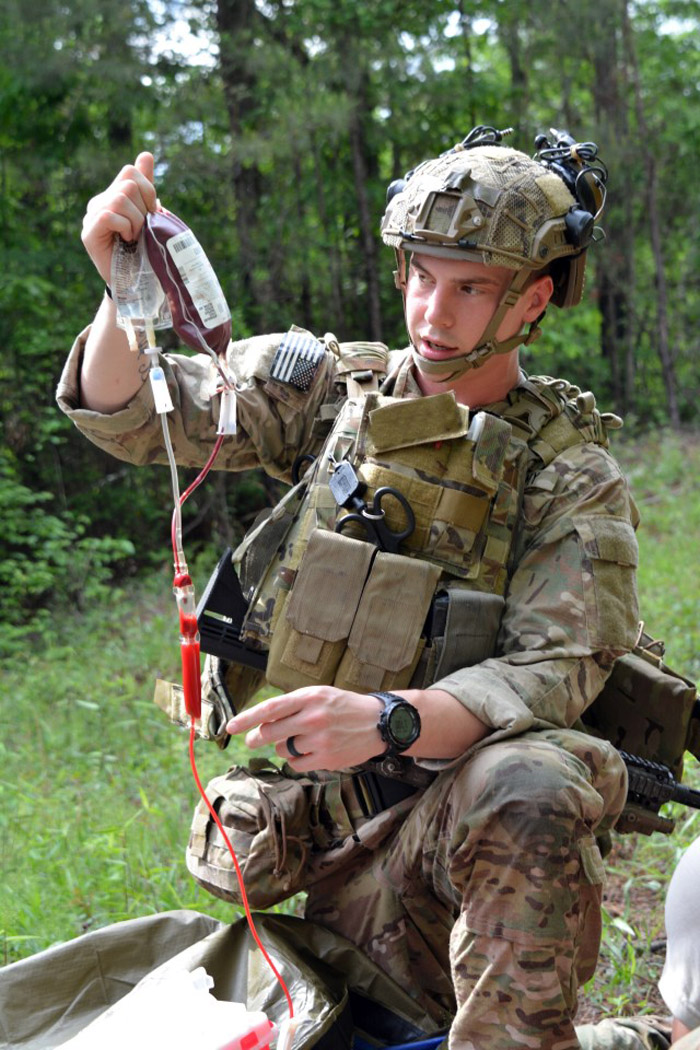
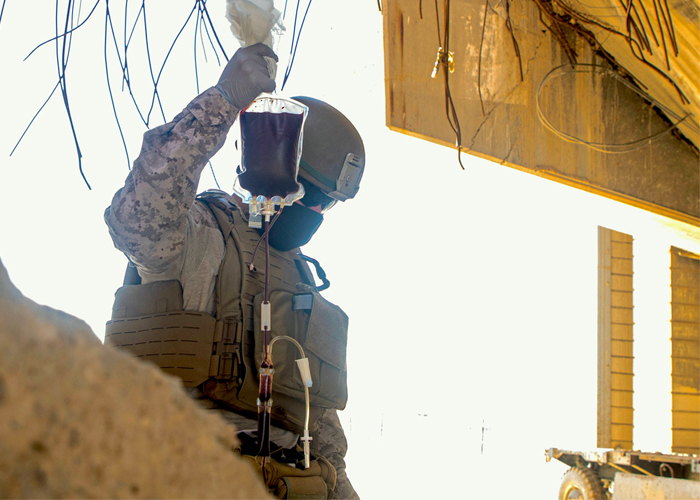
75th Ranger Regiment Medic trains to deliver whole blood on the battlefield (U.S. Army photo)
Chretien added, “This is truly a ‘DARPA Hard’ problem and an example of DARPA’s ability to facilitate the partnerships needed to achieve technological breakthroughs. To address FSHARP’s goals requires multiple universities and companies developing analogues of various blood components, simultaneous evaluation of multiple efficacy and safety features and interactions among components in various model systems, industrial-scale manufacturing capabilities that can adapt the lab-scale methods, and analytics to integrate large volumes of experimental data and guide further optimization. UMB has assembled a consortium with the broad set of capabilities needed to accomplish these tasks.”
With bleeding always a problem whether during war and peace as people get injured all the time. Having readily available artificial blood when needed on site until proper treatment can be given in a more formal medical facility can result to thousands of lives saved each year.
Top photo: Emergency Fresh Whole Blood Transfusion Training Program in Kuwait 18 August 2020. (US Marine Corps Photo)