Palmetto State Armory Brings Back The Harrington & Richardson H&R 606 HBAR
Gungho Cowboy
22 May 2026
There is a particular kind of firearms enthusiast who, upon hearing that Palmetto State Armory has resurrected the Harrington & Richardson H&R 606, will at once know exactly what it is and why it matters. Then there is everyone else who will need a brief history lesson before the excitement makes any sense. This piece is chiefly for the second group, though the first group is welcome to stay and feel quietly superior.
According to Impact Guns, in the early 1960s, Harrington & Richardson created the Model 606, the first-ever heavy-barrel AR-15, as a candidate for a military squad automatic weapon. The program quietly folded after the military rejected the design, leaving only a handful of prototype rifles in existence. For sixty years, these surviving rifles vanished into obscurity, achieving a near-mythical status among collectors who knew them only through rare photos and rumors.
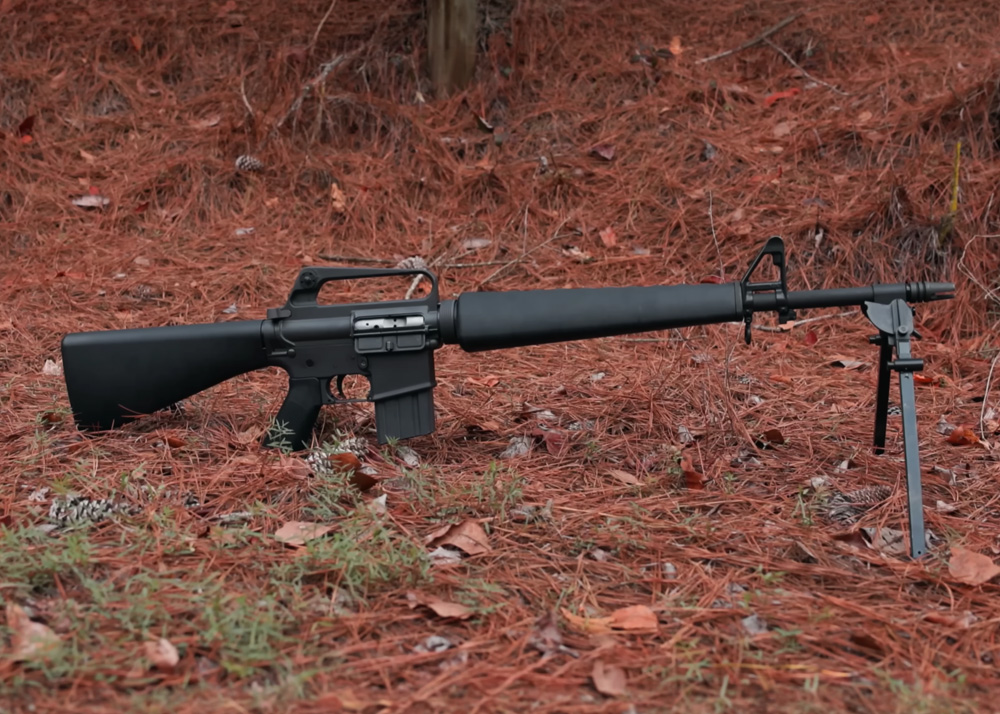
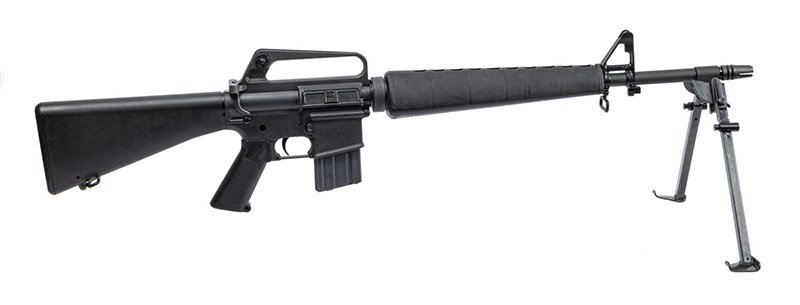
Palmetto State Armory, a South Carolina outfit that has built its reputation on producing affordable AR-15 pattern rifles and occasionally doing something rather clever with retro and historical configurations, has now decided to give the 606 a second life. The new H&R 606 is a faithful recreation of that forgotten prototype, dressed in the visual language of early 1970s military kit: slick-side upper receiver, M16A1 triangular handguards with heat shields, partial fence lower receiver marked M16, and that distinctive three-pronged flash hider that looks like it might equally serve as a toasting fork in an emergency. The whole ensemble is finished in either black or grey anodised aluminium, and the Parkerized barrel completes the period-correct aesthetic without anyone having to pretend it came from a different decade.
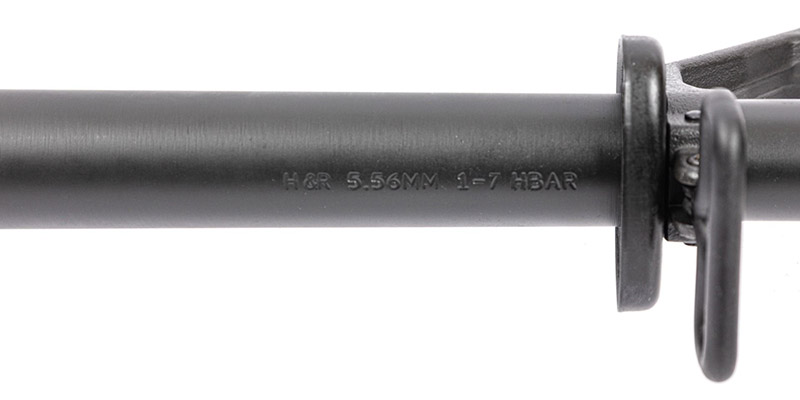
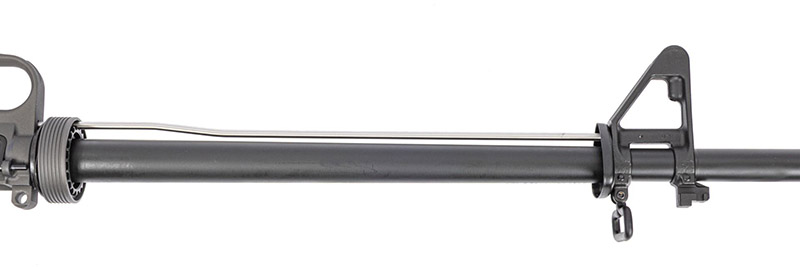
The specification sheet is where things get properly interesting for those who pay attention to such details. The 606 wears a 20-inch heavy barrel profile, the HBAR configuration that gives the rifle its weight-forward balance and its sustained-fire credentials, machined from 4150 Chrome Moly Vanadium steel with a chrome lining inside. Chrome-lined bores are not glamorous, but they are practical: they resist heat, resist corrosion, and will cheerfully survive the kind of treatment that finishes a bare-steel barrel in short order. The bolt is Carpenter 158 steel, chrome-finished, running in a full-auto profile bolt carrier that wears no serrations. The 1-in-7 twist rate stabilises the full range of 5.56 NATO projectiles competently. Everything here speaks to function first.
The bipod deserves its own paragraph because it is rather an odd and endearing detail. The M2 bipod fitted to the original 606 prototype was not designed for the 606 at all, it was adapted from the M14 rifle, where it served a rather different role supporting a considerably heavier weapon. The effect is a little like fitting a trailer hitch to a bicycle: technically it works, the proportions are slightly unusual, and it tells you something about the creative pragmatism of military procurement in that era. PSA has reproduced this arrangement faithfully, which is either a charming act of historical accuracy or a mild eccentricity, depending on your perspective. Either way, it gives the rifle a silhouette unlike anything currently in production.
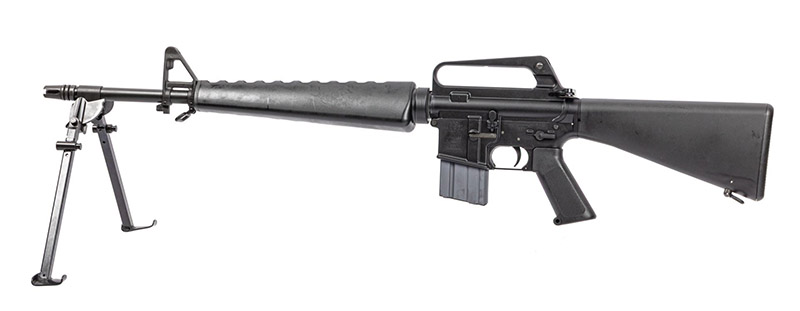
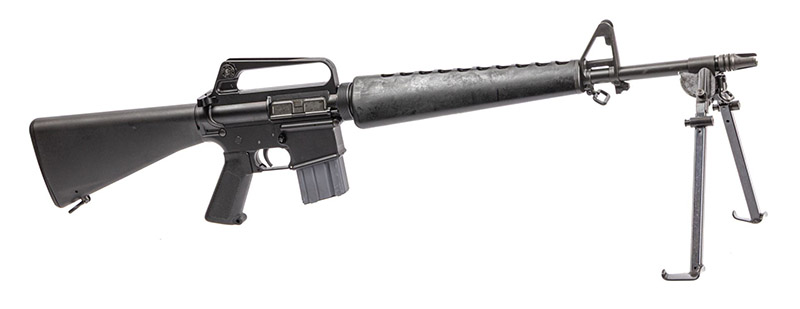
Harrington & Richardson 606 20" 5.56 NATO Rifle, Black
At nine pounds configured weight and 39 inches overall, the H&R 606 is not a compact rifle. It is, in fact, built to occupy space in a purposeful way, which is rather the point. This is a gun that rewards being rested on that bipod and pointed downrange, not slung across a chest rig at an obstacle course. The rifle-length gas system, running gas from 12 inches down the barrel rather than the shorter midlength or carbine positions common on modern ARs, produces a slower, smoother cycling action with less felt recoil, a characteristic the original designers presumably considered useful when asking a weapon to function as a light support arm.
PSA is offering the 606 in two configurations: complete rifles and complete upper receivers. The latter will appeal to those who already own a lower receiver and would prefer not to pay for a second, as well as those who enjoy the slightly complicated logistical dance of AR components. The muzzle is threaded at the standard 1/2x28 pitch, which means suppressor attachment is entirely possible, an anachronistic flourish on a 1970s prototype that the original designers certainly never anticipated but which the modern market absolutely expects. Twenty-round magazines are included, consistent with the period configuration, though anyone with a standard AR lower will find 30-rounders fit without complaint.
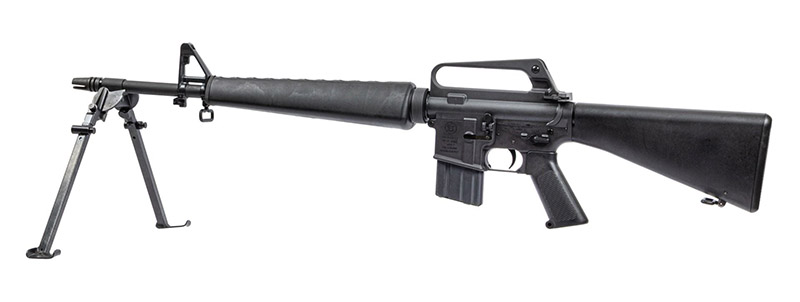
Harrington & Richardson 606 20" 5.56 NATO Rifle, Grey
It is worth reflecting briefly on what PSA is selling here, beyond the mechanical specifications. The H&R 606 belongs to a tradition of faithful retro recreations that has grown steadily over the past decade, driven partly by collectors, partly by historians, and partly by shooters who find the visual grammar of 1960s and 1970s military rifles rather more appealing than the Picatinny-railed, optics-laden, suppressor-ready configurations that dominate contemporary production. There is something honest about a rifle that does not pretend to be tactical in any modern sense of the word. It simply is what it is: a carefully made copy of a weapon that almost was adopted, wearing its historical footnote status with a certain dignity.
The H&R 606 will not change the industry, win any contracts, or alter the course of small arms development. It did not do those things the first time either. What it will do is give a curious corner of firearms history a physical, tangible form that people can shoot, examine, and appreciate, which is a rather better fate than gathering dust in a government archive. For a weapon that spent roughly four decades as a footnote, which seems a fair outcome.