Researchers Develop Camouflage Device That Can Hide Wearer From Thermal Imagers
Logan
11 Mar 2020
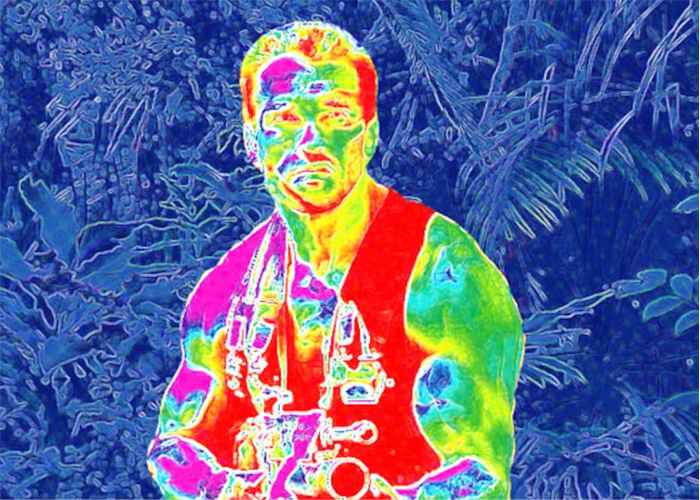
Too late for Major Dutch, played by Arnold Schwarzenegger, to use this in the movie “Predator”, but researchers from University of California San Diego have developed a camouflage device that can make the wearer be invisible from thermal imagers no matter the temperature. This development of course has big implications in a tactical manner as expensive thermal devices used in the military and police forces may be rendered useless by this development.
It’s not yet a mature technology as this for now is a proof-on-concept but the technology is easily understood. The wearable technology quickly adjusts and matches the ambient temperature that the wearer is in, especially at night since thermal cameras are effective at spotting people as they generate more heat in contrast to the cooler surroundings. Thermal imagers are not much effective during the day as temperatures are warmer and you can spot people easily with your own eyes under daylight unless they are under heavy camouflage and not doing any movement.
In the abstract of "An Adaptive and Wearable Thermal Camouflage Device", researchers Sahngki Hong, Sunmi Shin and Renkun Chen, briefly explain their concept:
Thermal cloaking and camouflage have attracted increasing attention with the progress of infrared surveillance technologies. Previous studies have been mainly focused on emissivity manipulation or using sophisticated thermal metamaterials. However, emissivity control is only applicable for objects that are warmer than the environment and lower emissivity is usually accompanied with high reflectance of the surrounding thermal signals if they have nonuniform temperature. Metamaterial‐based thermal camouflage holds great promise but their applications on human subjects are yet to be realized. Direct temperature control represents a more desirable strategy to realize dynamically adjustable camouflage within a wide ambient temperature range, but a wearable, portable, and adjustable thermo‐regulation system that is suitable for human subjects has not been developed. This work demonstrates a wearable and adaptive infrared camouflage device responding to the background temperature change based on the thermoelectric cooling and heating effect. The flexible thermoelectric device can realize the infrared camouflage effect to effectively shield the metabolic heat from skin within a wide range of background temperature: 7 °C below and 15 °C above the ambient temperature, showing promise for a broad range of potential applications, such as security, counter‐surveillance, and adaptive heat shielding and thermal control.
The demo video shows just a cuff that has a wax-like phase-changing material but is said to have more complex properties. Worn on the wrist, it automatically adjusts to the temperature with the surface going either warmer or cool to ensure that it matches the ambient temperature. Inside the cuff, the temperature remains constant so it is comfortable enough for the wearer.
Since the proof-of-concept is just a cuff, the researchers will now look into scaling the technology that can cover a person and are looking into materials are lighter and thinner since current conditions may lead to a heavier garment that can be effective for an hour.
This project is supported by the Advanced Research Project Agency (DARPA) and a start up grant by UC San Diego. This will take further research and development and thus, it is still not sure if this project will be able to become a new material that can be used by the military as it will be dependent on outcome of the research in the following months and years, subject to available resources to support it.
Top photo: Arnold Schwarzenegger as seen by the Predator using thermal vision in "Predator" movie (20th Century Fox)