U.S. Army Working On Integrating Power Cables Into Tactical Vests
Logan
11 May 2020
The 21st Century warfighter carries enough electronic gear that managing cables and batteries is becoming a headache for the him/her and causing additional weight which will then affect mobility and agility. The U.S. Army’s Futures Command (AFC) is working on solving and reinforcing the dismounted soldier’s power capabilities by developing integrated, flexible cables in line with the new generation modernization priorities. According to the Combat Capabilities Development Command (CCDC) researchers, new cables will integrated into tactical vests.
As posted at the U.S. Army website, the CCDC’s C5ISR or the Command, Control, Communications, Computers, Cyber, Intelligence, Surveillance and Reconnaissance Center has partnered with the CCDC Soldier Center to look into power solutions to support programs being developed across the U.S. Army such as the Nett Warrior, Next-Generation Squad Weapons (NGSW) and Integrated Visual Augmentation System (IVAS). Just the mere mention of these names makes it obvious that increasing dependence of the soldier into electronic and smart devices so that they can share data and information. Thus, managing cables and power sources is very much an imperative mission for the researchers so these programs are integrated seamlessly.
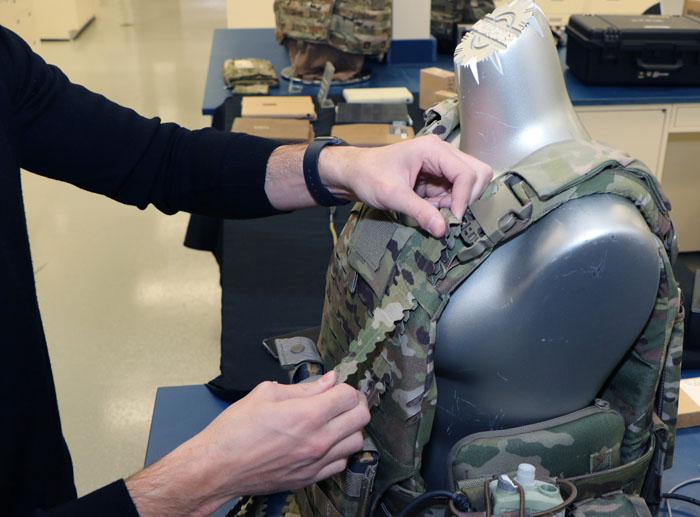
Photo Credit: Dan Lafontaine, C5ISR Center Public Affairs
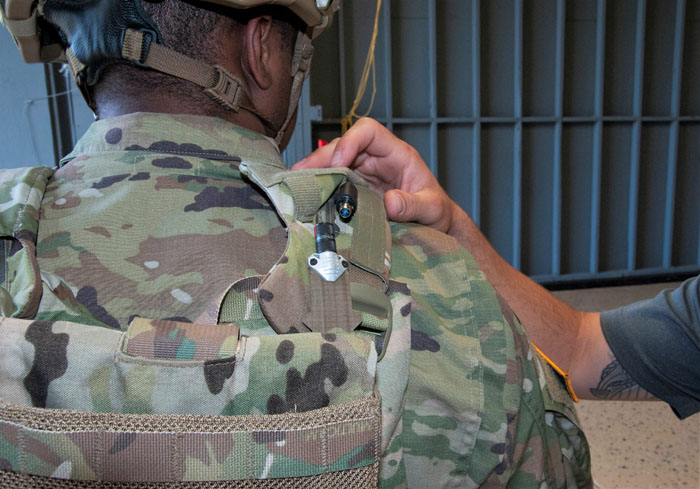
Photo Credit: U.S. Army
Ethan Wise, the C5ISR Center project leader for the project said, “This new flexible cable is up to 50 percent lighter than the legacy version. It’s much more flexible, less bulky and removes cabling that encumbers a Soldier’s motion when connected to a Conformal Wearable Battery.”
He adds, “It reduces snag hazards because it can be looped through a tactical vest several times. The new cable feels like the fabric of a standard Army uniform and blends in seamlessly with the camouflage pattern.”
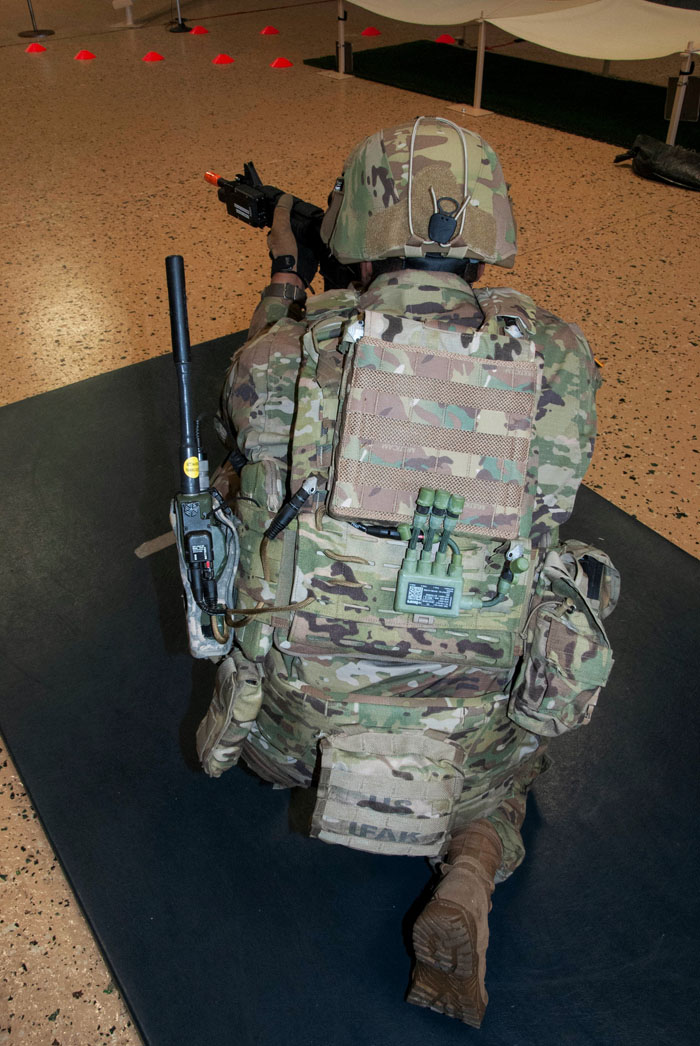
Photo Credit: U.S. Army
The cable was initially developed by the a company based in the United Kingdom, through the Foreign Comparative Testing (FCT) Program. The FCT allows Army science and technology organizations to find and evaluate solutions to meet the operational needs of soldiers regardless of the origin of the technology’ they looking into.
While the FCT program was initially focused on the Nett Warrior system, results of the technology developed are being leveraged by the CCDC in the NGSW and IVAS. For the NGSW, which will replace the M4 service rifle and the M249 SAW, they are working on a sling with materials to support the cables as well as storing energy and power to the weapon. For the IVAS, which is based on the Microsoft Holo-Lens, is a heads-up system that has augmented reality features and aided target acquisition, it will need to be connected to a power source for longer duration of usage.
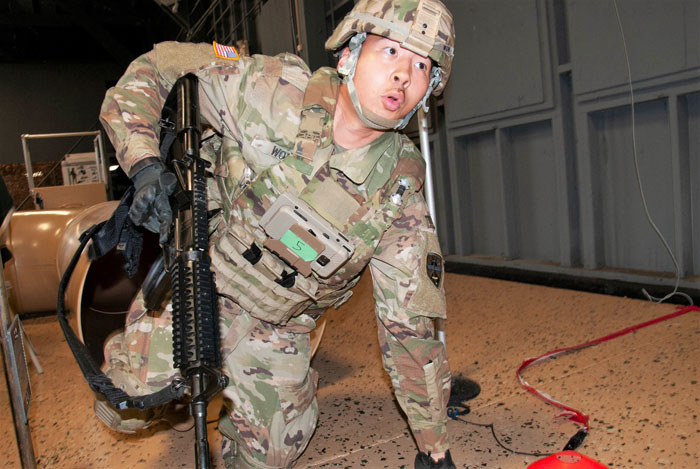
Photo Credit: U.S. Army
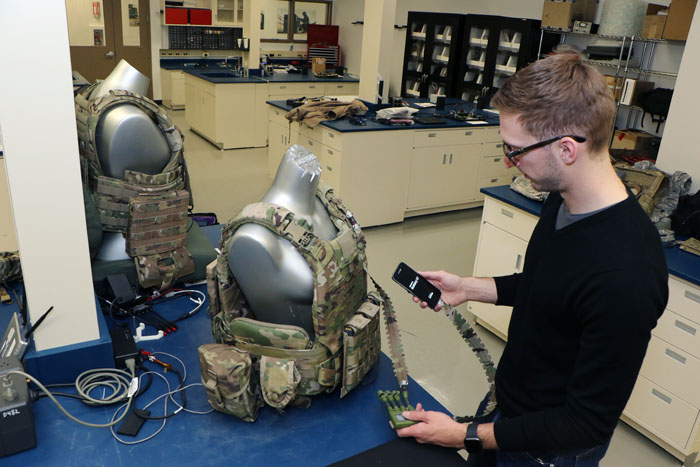
Photo Credit: Dan Lafontaine, C5ISR Center Public Affairs
“These new weapons will be equipped with sophisticated technologies, likely requiring more power,” said Dr. Nathan Sharpes, C5ISR Center research mechanical engineer. “The straight-forward solution would be to tether the weapon to a larger battery on the vest. However, this introduces a snag hazard and historically hasn’t been popular among Soldiers. Routing power through the sling should yield a more acceptable and familiar-feeling solution.”
The C5ISR Center engineers will continue to work on prototypes for potential use for the NGSW and IVAS in 2020.
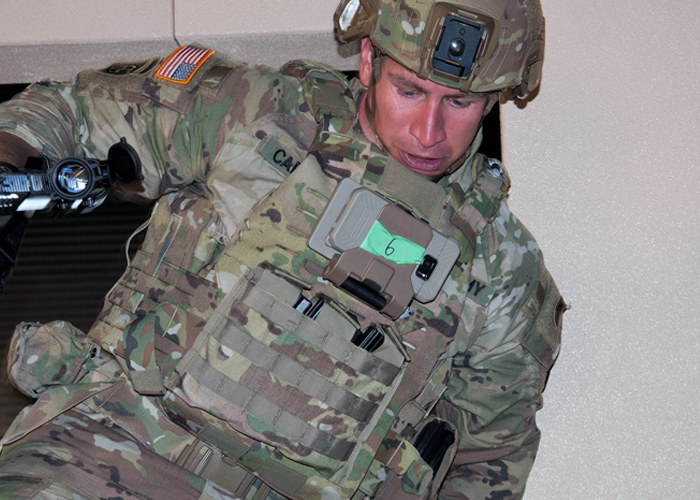
Top photo: A soldier goes through an obstacle course to test the integrated, flexible cables at the Aberdeen Proving Ground, Maryland, in August 2019. (Photo Credit: U.S. Army)