US Army's CCDC Chemical Biological Center Tests Materials Best Suited For Homemade Face Masks
Gungho Cowboy
27 Apr 2020
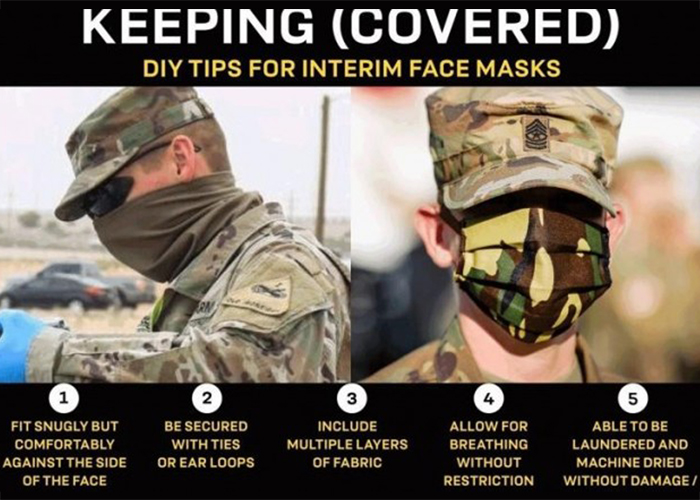
With a shortage of PPEs such as eye protection, protective gowns, face shields, and lower face masks have forced to governments to tell their citizens not to compete in purchasing such PPEs so that these can be devoted to frontliners, non frontliners will have to resort to making their own PPEs based on materials that they can lay their hands on.
Now, the good thing is that there is no shortage of tips of making your DIY PPEs. Just go online and search for tips and videos, the internet is awash with information in whatever language you like. There are also authoritative sources on what materials to use to build your own effective face masks or face shields and even protective gowns. But if you need more information to ease your mind in procuring materials for your homemade face mak, you might want to read on the results of the tests conducted by the U.S. Army’s Combat Capabilities Development Command (CCDC) Chemical Biological Center.
In a press release, scientists at the Combat Capabilities Development Command, or CCDC, Chemical Biological Center have tested more than 50 common household fabrics to determine the filtration efficiency of each. They did the tests as they were contacted by 30 defense agencies, federal agencies and health organizations for assistance in addressing the shortage of personal protective equipment (PPE).

Scientists at the Combat Capabilities Development Command, or CCDC, Chemical Biological Center have tested more than 50 common household fabrics to determine the filtration efficiency of each (Photo by: Jack Bunja)
David Caretti, chief of the Center’s Chemical Biological Protection & Decontamination Division and leader of testing team said, “The challenge is to pick a material that effectively blocks the virus particles from going through the material while not being too hard to breathe through. If the resistance is too high, airflow will simply bypass the covering and go around the edges.”
He added that, “We knew that claims about masks and face coverings were exploding all over the internet, and we wanted to make sure that any decisions about materials these agencies make will be based on proven science.”
According to their tests, the best off-the-shelf material amongst the over 50 materials they used is the four-ply microfiber cloth that can be found at most stores. The material can filter out 75% of materials as compared to N95 masks which can stop up to 95% of particles of around 0.2 to 0.3 microns. Whilst the corona virus is 0.125 microns, it gets transferred in droplets 0.2 microns or bigger. The DIY homemade face mask may not be as effective as the N95 mask that is needed by the frontliners, it is way better than not having face mask at all.
With the knowledge of the best material that is readily available for those who want to make their own face masks, they can procure materials to make their own masks by following this link on YouTube. They can choose styles they want to, from no sew to sewn ones. There are recommended mask designs that require more layers for better protection as long as they are comfortable and breathable.
If you intend to make your homemade masks using the recommended material, why not procure more of such material and make more than what you need? The excess masks can then be donated to those who need it, and if the local medical centres and frontliners find them suitable to their needs, then you can donate to them as well. It’s better to have some protection that nothing at all.
Top photo: Fort Belvoir face covering policy