U.S. Marines Go Against Robot Targets At A New Live-Fire Range
Logan
16 Dec 2020
For most militaries, live-fire training exercises involve shooting at static targets prepositioned in the training area. If against a moving opposing force, they resort to Multiple integrated laser engagement system (MILES) with blank firing or sometimes use of simunitions or even the use of airsoft guns. But having a live-fire training that involves actual moving targets make for a more immersive experience.
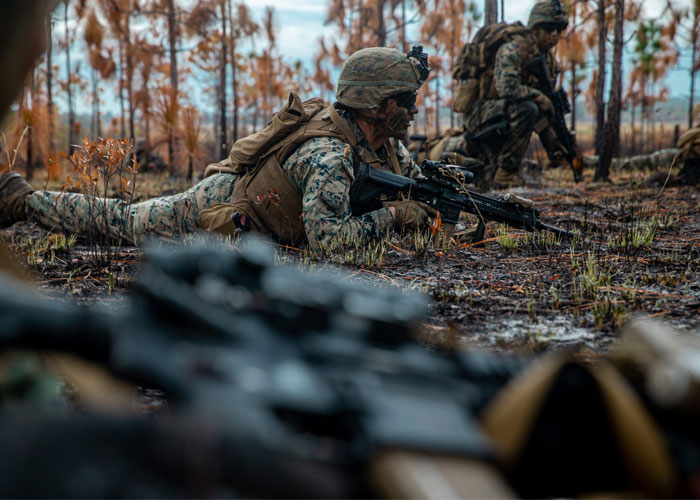
The U.S. Marines are now able to do just that with the opening of a new live-fire range. Over the weekend, the 3rd Battalion, 6th Marines conducted a live-training exercise at the newly opened Range Golf 36 (G-36) at Camp Lejeune, and they were against robot enemies that can move in different directions, react when fired upon, and able to conduct an assault against the Marines.
Military.com reports the new range as setup to incorporate the robotic combatants that will be able to use the trenches and terrain to move for cover as well as use such to mount a charge against the Marines. The video below shows an older exercise as conducted by the 1st Battalion, 3rd Marine Regiment at the Marine Corps Air Ground Combat Center, Twentynine Palms, Califonia in 2018:
"The majority of the current U.S. Marine Corps population has not seen a world where the U.S. was not the dominant force," 2nd Marine Division gunner Chief Warrant Officer 5 Joshua Smith said in a released statement. "As the Corps transitions to the peer and near-peer fight, we strived to produce a live-fire problem set which removes the three-to-one advantage the Marine Corps typically enjoyed."
The robot targets are supplied by an Australian company, Marathon Targets. The company has been developing these targets for over a decade, starting with the use of Segways and now with four-wheeled human-shaped targets that drop when hit. These are rugged targets as they are armored so they can take the punishment of a live round.
To operate these, they are wirelessly controlled and can follow pre-set scenarios for a training exercise. The company claims that, “Documented tests and evaluations carried out by the US Marine Corps determined that soldiers developed a 104% increase in combat accuracy within a 24 hour period through use of our robotic targets. In addition, the US Army’s Research Institute measured a 3.7 times increase in range throughput compared to traditional training methods.”
G-36 is still a unique setup as the use of robot targets for live training exercises is not yet a set standard. The robots are expensive as well so it can be a cost issue. But if the benefits in terms of combat effectiveness as brought about by this type of training devices, then they can be accepted and implemented at various training camps not only for the Marines but for other branches of the U.S. military as well.
Top photo: 3rd Battalion, 6th Marine Regiment, 2d Marine Division, buddy rush during live-fire assaults at G-36 in Camp Lejeune, North Carolina last December 12, 2020. (U.S. Marine Corps photo by Lance Cpl. Jacqueline Parsons)